
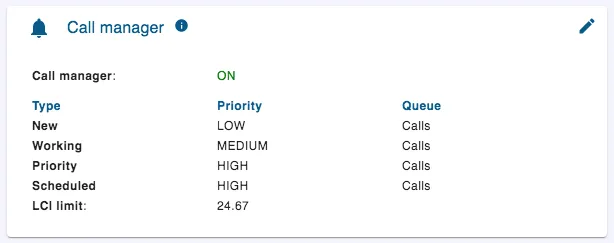
The call manager is on the "Call manager" card in Settings (an admin saves it). Ticking "Call manager on" shows the line details and the LCI gauge in the call log, and follow-up call tasks are automatically filed into a queue with a priority, based on a combination of;
- Contact status (uncontacted vs contacted)
- The ProspectSafari Line Connect Index (LCI);
Turn Call Manager ON to improve your call connect rate
The LCI is predicted based on a multivariate analysis of hundreds of thousands of calls yielding a dynamic weighting of each variable depending on the country of call destination.
Provided the call data for each contact is faithfully recorded then the machine learning algorithms yield actionable predictions of the relative connect rate for successive call attempts, and hence the LCI is calculated.
Specifically, in the call log it is important to only record "Outgoing call (connected)" when you have connected with the contact. This will increase the LCI and also change the lead status to "Contacted" and adjust your analytics and Scorecard accordingly. An incoming call raises the LCI too. If you spoke with someone but not the contact, record this as “Live Message”.
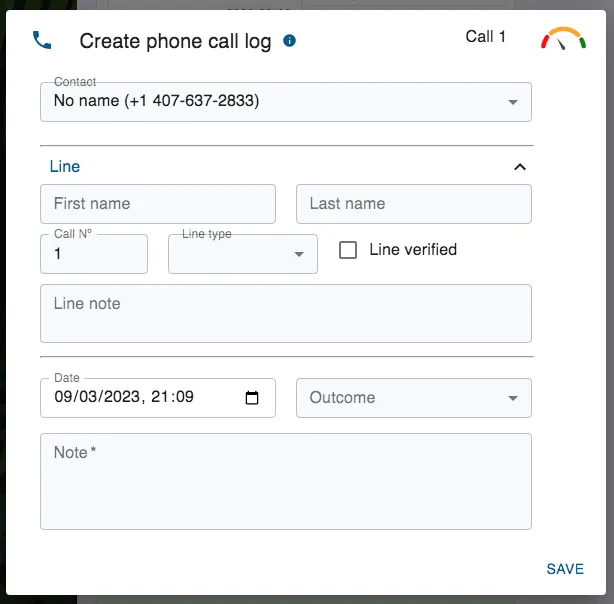
The calculated LCI is shown per phone number in the contact section ("Phone line connect index", with the "Call attempts"), as the list view column "Line connection index", and as a gauge in the call log popup ("Likely to connect" / "Unlikely to connect") like this:

A high LCI indicates a higher likelihood that the contact will answer the call.
Setting different priorities and queues for each type of call task is optional. New workspaces get a queue called "Calls", and the four rows below start on it with the priorities Low (New), Low (Working), Medium (Priority) and High (Scheduled), until an admin changes them. Many users simply call in the order of the LCI (see "Call List" below), and this alone will typically double their call success rate.
The Call Manager settings allow you to set the "Priority" and the "Queue" for the following call task categories (or "buckets"):
- New: first calls to uncontacted prospects
- Working: repeat call tasks with LCI < limit
- Priority: repeat call tasks with LCI > limit
- Scheduled: agreed calls ("Scheduled call" chosen for a contact you have already reached)
It is good practice to add scheduled call tasks to your calendar (like a meeting). ProspectSafari will do this automatically if you set the priority to High for scheduled calls.
By setting the "Line connect index (LCI) limit" the partition between Working and Priority call tasks is adjusted, as is the red arc on the LCI gauge.
With the call manager on, the call log popup shows the gauge and "Call N" at the top right, and a clock with the contact's local time at the top left when the number's country or time zone is known.
LCI gauge in call log popup
Some key elements to calculate the LCI are added in the call log, in a fold-out line under the deal that reads, for example, "Direct line (Verified)". These include the "Line type" (or "Unknown"):
- Direct (eg mobile or direct line)
- Gatekeeper (eg via reception or PA or other live person)
- Menu (IVR or automated menu eg “key 3 for sales”)
- Invalid (confirmed impossible to reach contact on this line)
In addition the "Line status" is asked: "Not verified", "Verified" or "Bad number". Choose "Verified" if your contact's name was recognised or acknowledged; for instance if you asked the receptionist for "John Smith" and you were connected, or if you reach a voicemail message "This is John, please leave a message". If not, leave it at "Not verified". Choosing the outcome "Wrong number" marks the line "Invalid" / "Bad number" for you, and the reverse.
Finally, "Call Nº", the call attempt number (this is counted from the recorded call history but can be changed). Call attempts count per phone number; an incoming call does not count as an attempt. You can also add a "Line note".
Note that Line type, Line status and Call Nº are specific to a phone number for a specific contact. The same phone number may have different settings for a different contact.
For the optimal performance of call manager and to ensure the production of useful analytics and scorecard metrics, it is important that every call is recorded with a call log; in practice this means simply selecting the correct call outcome (do not select “outgoing call” unless you successfully connected and spoke with your contact).
Most call attempts will result in no answer, leaving a live message or a voicemail. After every new call log you are asked "Reschedule call?" to set a follow-up call task ("Scheduled call", "Today", "Tomorrow" ... "In 4 weeks"). It is automatically assigned a priority & queue based on;
- your call manager settings
- the predicted LCI for the next call
A contact with no call attempts yet is "New"; after that "Working" or "Priority" by the contact's LCI; a contact already reached goes to "Priority", or to "Scheduled" when you pick "Scheduled call". The "Reschedule call?" choices use these rows even when the call manager is switched off; if the rows were never set (the card shows "NONE"), they make no task.
In Saved Filters, select “Calls Today”
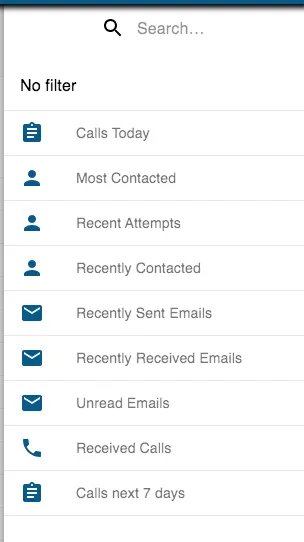
Some workspaces have saved filters such as "Calls Today" or a "Call List" sorted by LCI (they came with the workspace's starting setup or were saved there). If yours doesn't, open "Tasks" in the list view, sort or filter the call tasks the way you want to work, and save it as a filter: it then shows under "Saved filters" and in the queues panel. ProspectSafari does not reorder tasks across queues by itself.
- By always following this call order, you should double your connect rates
- Typically, those at the top of the list are 3-4x more likely to connect than those at the bottom.
It is important to always add fresh, new prospects into the call process.
Ultimately it is a better use of your time to be attempting to call someone who might pick up, rather than someone who is far less likely. If the LCI is too low you should try to find an alternative number to call or a different contact within the prospect, or move the prospect to a drip marketing campaign and focus you calls on prospects with a higher LCI